Collection5 min read
When to throw out makeup and skincare
Use your Beauty Board catalogue to sweep the drawer: how to tell when something has turned, and an empties list so finished products stay honest.
Everyone owns a mascara they cannot date and a cream that smells faintly different from when it arrived. This piece is a drawer sweep you can run against the products you have already saved in Beauty Board. Treat timelines as general guidance, not guarantees. Beauty Board does not track expiry for you. When in doubt, especially near the eyes, bin it.
How long does makeup last once opened?
Counting starts when you open it, not when you buy it. As a rough guide: mascara and liquid liner last about three months of use. Liquid foundation and concealer last around a year. Lipsticks last a year or more. Powders, blushes, and bronzers last longest, often two years, since dry formulas give microbes little to work with. Pencils that get sharpened last well because each sharpening exposes a fresh surface.
Skincare follows the same principle. Most creams and serums last six to twelve months once opened. Sunscreen should be treated as a single season once opened: its protection is the whole point, and degraded protection fails silently. Anything in a jar lasts less well than the same formula in a pump, because fingers introduce more each time.
These are guidance ranges, not safety promises. Storage, climate, and how the product is handled all shift them. The signs below matter more than any number.
The period-after-opening symbol, and what it actually tells you
The small open-jar icon printed on packaging carries a number like 6M or 12M. That is the maker's guidance for how long the product stays good after opening. It is worth glancing at when you open something new, and almost nobody remembers it afterwards.
Beauty Board is not an expiry calendar. If a date helps you, put a one-line note on the product record when you open it. The catalogue then has something to read at the next sweep, instead of a drawer full of mystery jars.
The signs that matter: smell, texture, separation, colour
Trust your senses over the calendar. A product that has turned usually announces it.
Smell. Anything rancid, sharply chemical when it was not before, or simply off from what you remember. Creams with natural oils turn noticeably.
Texture. Clumping mascara, grainy cream, lipstick that drags. Separation in a liquid that does not re-mix with a shake.
Colour. Yellowing, darkening, or any shift from the shade you bought. Foundation that oxidised in the bottle is done.
Performance. Sunscreen that pills where it never did, base that will not blend, nail polish gone thick and stringy. A product that stopped doing its job has told you its answer.
Any one of these means bin, regardless of the date. No rescue, no "use it on the hands." A turned product is waste, not a bargain to extract.
Mascara and liquid liner are the strict ones
Eye products deserve the shortest leash. The eye area is vulnerable, the tube is dark and wet inside, and the wand travels between lashes and tube twice a day. Three months of use is the guidance, and an eye infection costs far more than a replacement.
Never share eye products, never add water or lens solution to revive a drying mascara, and bin anything used through an eye infection immediately rather than keeping it. Pencils are more forgiving since sharpening renews them, but the same infection rule applies.
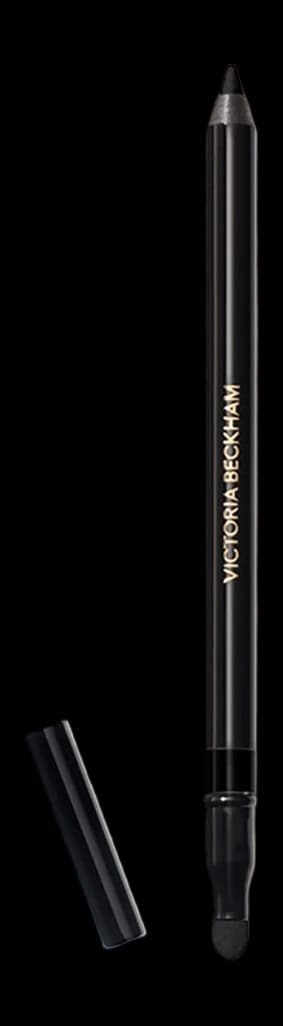
Victoria Beckham Beauty
Satin Kajal Liner
Pencils are the products you cannot date. The shade name plus roughly when it arrived beats guessing.
Victoria Beckham Beauty
Skincare: actives, sunscreen, and anything in a jar
A few categories need extra attention. Active serums lose strength gradually once opened, so an old one may be perfectly safe and simply weaker. That still means replacing it if you want the effect. Sunscreen past its season should be replaced rather than trusted, since failure is invisible. Jar products depend on handling: clean dry hands or a small spatula each time, never double-dipping, and a lid kept properly closed.
Unopened products are a different matter. Sealed, stored away from heat and light, most last until the printed date. The drawer sweep below is about opened products. Leave the sealed backups alone unless they are years old.
A drawer sweep you can finish in twenty minutes
Once or twice a year, pull everything out and decide fast. Have Beauty Board open so you are deciding against records, not against a jumble.
- Search or filter by category: eyes, base, lips, skincare. Decisions are easier among peers, and even easier when the packshots sit in a row.
- Bin anything with the signs above, anything mascara-like older than a season of use, and anything you cannot date that looks suspect. Take those products off your boards and routines.
- Bin the "someday" products too: the shade that never suited you, the serum from three routines ago. Expiry aside, they are clutter.
- Wipe the drawer, the lids, and the outside of the keepers. Half the grossness of a beauty drawer is packaging, not product.
- Put finished products on an empties list, with a note on whether you would repurchase. Mark the keepers Using.
What to write down so the next sweep is easier
The sweep is fast when the catalogue already knows what you own. Rough opening notes on the record turn next year's decisions from archaeology into reading. The bin list from how to declutter a makeup collection without regretting it pairs naturally: what left, why, and whether the keepers earned their place.
Twenty minutes, twice a year, plus a paste when something new arrives. The drawer stops being a museum of old hope and goes back to being a shelf you can trust.
Written by Beauty Board
Notes on saving and curating beauty from the Beauty Board team.